Best Toothpick Drones for 2026
Toothpick drones have become one of the most fun categories in FPV flying, and if you’re thinking about grabbing one, you’ve landed in the right place. Whether you want something that weighs next to nothing and absolutely rips, or you’re after that perfect balance of durability and performance, there’s a toothpick out there with your name on it. I’ve rounded up the best options for 2026, tested their specs against real user feedback, and picked out the ones that actually deliver.
What makes toothpicks so special? These tiny, lightweight drones hit a sweet spot—they fly like mini acrobats, they’re affordable enough that you won’t cry if you crash them, and here’s the kicker: they’re so light that in the US you don’t need to register them with the FAA (they stay under 250 grams). That’s huge if you want to fly without the extra paperwork. Keep reading to see which models are worth your money right now.
Here’s our curated list of best toothpick for 2026.
Flywoo Firefly 2S Nano Baby 20 – Best Overall
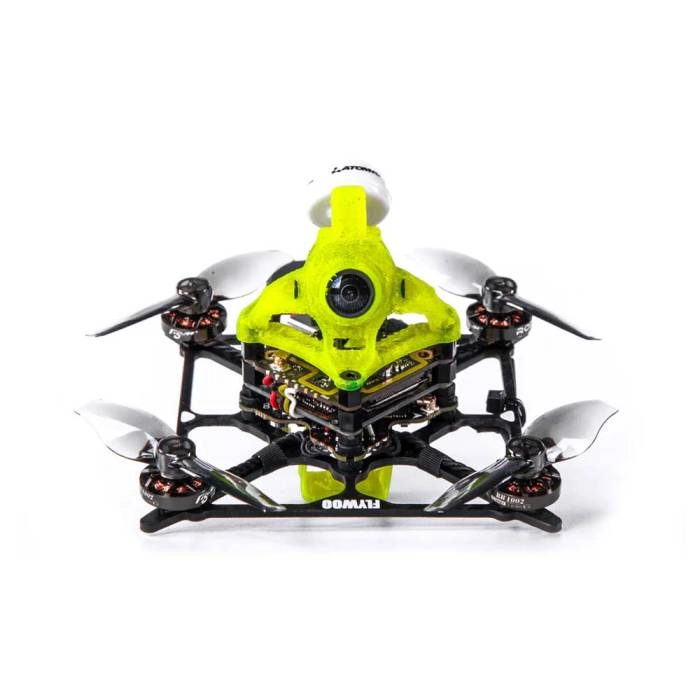
The Flywoo Firefly 2S Nano Baby 20 is the workhorse of the toothpick world right now. It’s the most versatile option available because it comes with four different VTX options: analog, DJI, Walksnail, and HDZero. That means whether you’re flying analog FPV goggles or you’ve already invested in digital, there’s a version waiting for you.
**What makes it stand out?** The onboard blackbox. Seriously, this is incredibly rare in toothpick AIO flight controllers, and it makes tuning and troubleshooting insanely easier. The FC is a Flywoo GOKU Versatile F405 2S 12A AIO—basically the most feature-rich AIO for 2S micro drones you can get. You get six UARTs, built-in ELRS 2.4GHz receiver, a barometer, and that blackbox I mentioned.
The frame is super clean, weighs just 34.9 grams without battery, and the motors (Flywoo ROBO 1002 15500KV) give you smooth, efficient flight. Flight time sits around 5-10 minutes depending on your battery size, and the VTX can push up to 450mW—more than solid for outdoor flying.
Users love this drone for how right out of the box it feels. The default tuning is so good that I could focus on learning to fly instead of messing with PIDs all day. Another highlight is the camera angle can’t be adjusted on the base model, but honestly, that fixed angle works for most people.
HappyModel Crux 3 – Best for Efficiency and Lightweight Flying
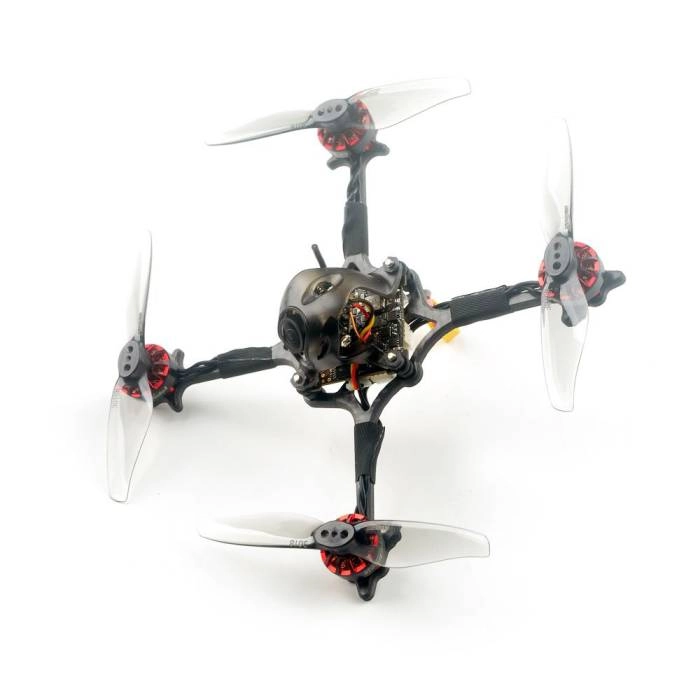
The HappyModel Crux 3 is basically the poster child for the original toothpick design. It nails the ultra-lightweight, maximum-efficiency formula with its Tiny Whoop-style central canopy and 3-inch biblade props. You can fly this on 1S or 2S, but 2S is the sweet spot—you get way more punch without sacrificing that light, floaty feel.
Why pilots love it: It’s the closest thing to pure toothpick flying. The Crux 3 comes with an AIO that’s a Crazybee flight controller with integrated ELRS 2.4GHz receiver, and the weight is kept insanely low. The frame design lets you mount an Insta360 Go for HD footage without breaking the laws of physics (okay, just barely). The motor/prop combo is efficient enough that you’ll get solid flight times on modest battery sizes.
The trade-off? It’s twitchy by default. If you’re new to acro flying, you might want to adjust your rates. But that’s kinda the point with a toothpick—they’re supposed to be agile little things.
DarwinFPV Tiny Ape – Best for Cinematic Flying
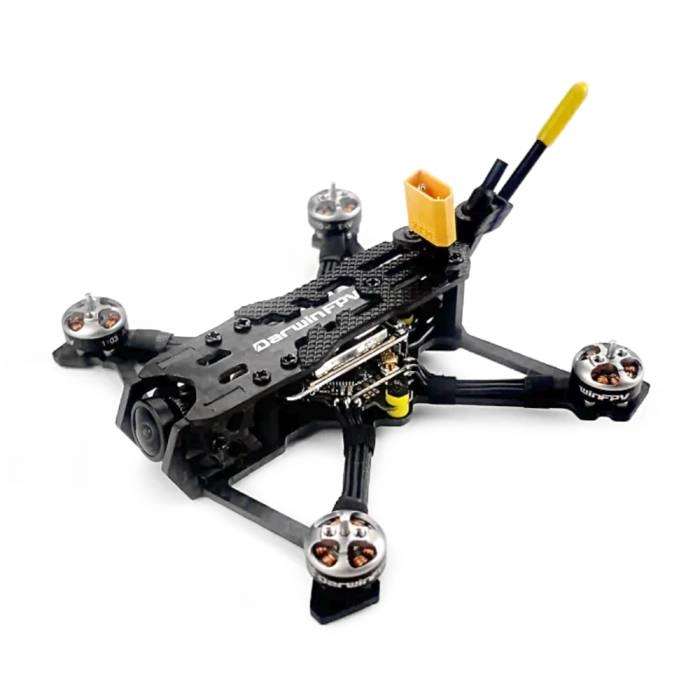
The DarwinFPV Tiny Ape is the rebel of this list—it ditches the traditional X-frame design for a “school bus” style frame that pushes the camera forward. That means your props and motors stay completely out of frame during cinematic flying. It’s a 2.5-inch design running 1103 8000KV motors, and it absolutely rips.
What’s special: The camera positioning is genius for FPV pilots who want smooth, cinematic-looking flights. The battery is top-mounted for better center of gravity, which helps with stability. The Darwin ELRS2.0 F411 flight controller is solid, and the VTX006 can output 25-600mW—the highest power output in this bunch.
The Tiny Ape is a completely different flying experience compared to traditional toothpicks. The props are totally hidden from the camera, and the smooth flight is so satisfying.
The trade-off: It’s heavier than pure toothpicks (around 50g), and the 2.5-inch props aren’t as efficient as 3-inch designs. But if you care more about how your FPV footage looks than total efficiency, this is your drone.
NewBeeDrone LionBee 1S – Best for Ultra-Long Flight Times
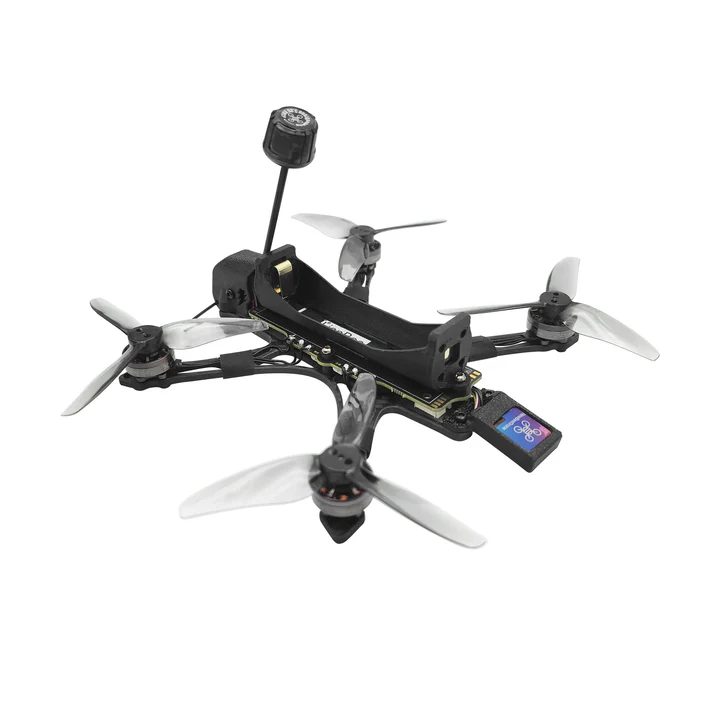
The NewBeeDrone LionBee is one of the newest options (2026 release) and it’s got a unique trick: it runs on a single 18650 battery. Yes, the same batteries you might have in your flashlight or laptop. That means insanely long flight times—we’re talking 17+ minutes of cruising on a single charge.
Why it’s different: Most toothpicks use LiPo batteries, but the LionBee’s 18650 setup gives you serious energy density. The drone itself weighs only around 68 grams without the battery, and it’s designed specifically for long-range flying. The AIO includes ELRS 2.4GHz, a solid 5.8G VTX (25-200mW), and the flight controller is dialed in for smooth, efficient flying.
The flight time is unexpectedly long for for a 1S drone, and using Li-Ion batteries means it is easier to manage than LiPo.
GEPRC Smart HD Toothpick – Best for DJI Digital FPV
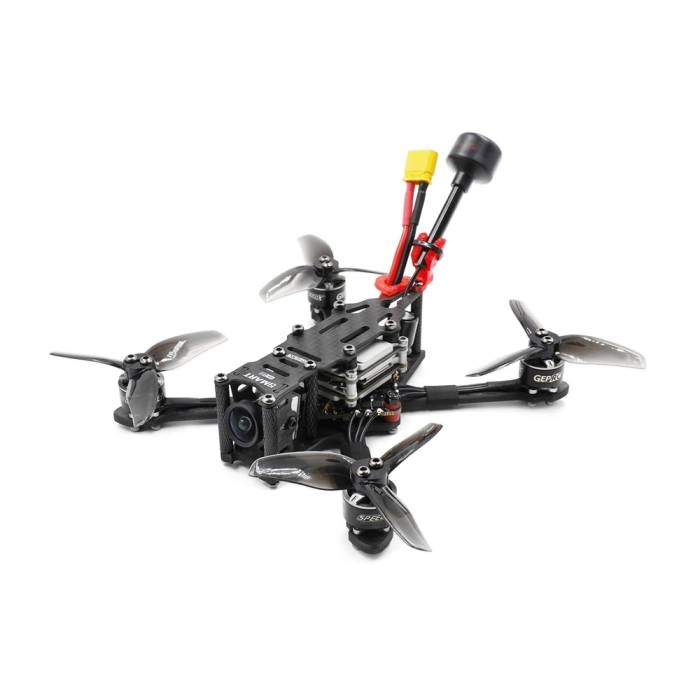
If you want toothpick-level agility with proper digital HD video, the GEPRC Smart HD is worth your attention. This is a 2.5-3 inch design that supports 4S batteries and comes with DJI Vista digital FPV—meaning you get that high-quality, low-latency video that DJI is known for.
It weighs around 92 grams (pretty light considering the 4S capability), uses GR1105 5000KV motors, and the flight controller is the latest GEP-F411-35A. You get stabilized HD video and enough power to do quick freestyle moves without feeling sluggish.
What Even Is a Toothpick Drone?
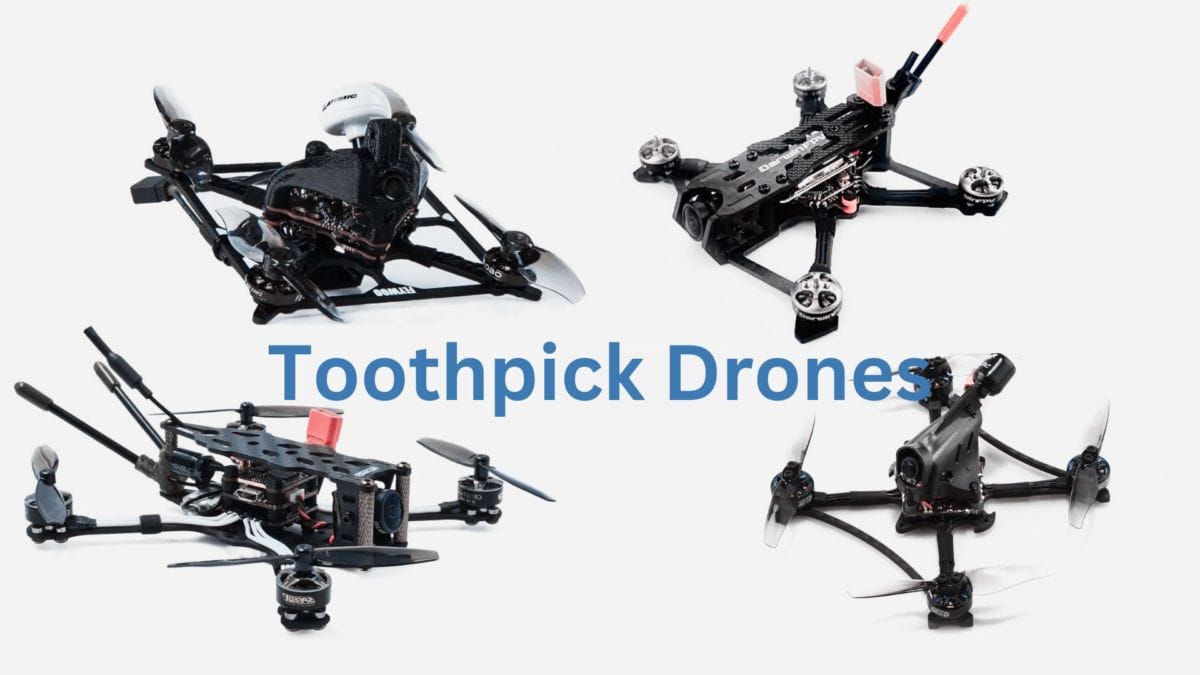
A toothpick is basically a small, ultra-lightweight FPV drone that uses 3-inch props or smaller, usually without prop guards. The name comes from how skinny and minimalist the frames are—they’re designed to shed every single gram that isn’t strictly necessary for flight.
Here’s the key: there’s no official “toothpick standard,” which is why you’ll see drones ranging from 35 grams to 100 grams all claiming the title. Generally though, if it’s under 100 grams, uses 3-inch props or smaller, and prioritizes lightweight efficiency over everything else, it’s a toothpick.
The design philosophy is simple: less weight = more agility, faster acceleration, and longer flight times relative to battery capacity. It’s the opposite of building heavy and beefy; toothpicks are all about finesse.
Why Flying Toothpick Drones? What Are the Advantages?
Affordable Price
Toothpick drones are genuinely cheap to get into. We’re talking $100-$300 depending on how fancy you want to go, versus $400-800+ for a 5-inch freestyle drone. If you break one, it doesn’t feel like a financial disaster.
No FAA Registration (in the US)
Because toothpick drones stay under 250 grams, you don’t need to register them with the FAA—no paperwork, no remote ID headaches. You still need to follow all other flying rules (airspace restrictions, line-of-sight flying where applicable, etc.), but the registration stuff is gone. That’s a huge convenience factor.
Surprisingly Durable
This sounds backwards, but lightweight drones crash better. When you hit something, the impact energy is way lower than a 5-inch screaming into a tree. Yes, you’ll break stuff, but the damage is usually fixable. Users consistently say toothpicks feel MORE durable than expected.
Agile and Powerful (Despite Being Tiny)
Even on 2S batteries, toothpicks fly with serious authority. The power-to-weight ratio is insane. You can do flips, rolls, and acrobatic moves that feel impossibly fast for such a small drone. And they’re more responsive than tiny whoops—they feel like “real” FPV drones just… compact.
Easier Battery Management
Most toothpicks run 1S or 2S, which is way safer and easier than managing 4S or 6S batteries. Fewer cells means less heat buildup, fewer LiPo incidents, and batteries that are easier to store safely. If you’re new to FPV, this alone is worth it.

What Are the Disadvantages of Toothpick Drones?
Difficult to Build and Repair
Toothpick drones are NOT beginner-friendly to build. Every component is tiny, soldering pads are microscopic, and one slip of the iron can toast a part. If something fails, repair costs can be steep because many toothpicks use all-in-one (AIO) boards. Break the FC? You’re replacing the whole thing, not just swapping a module.
Limited Features
Because space is premium, you can’t easily add GPS, buzzer, or other accessories. What you get out of the box is what you fly with. If you want to add features later, you’re either out of luck or building a whole new drone.
Expensive if the AIO Fails
Since most toothpicks use integrated AIO flight controllers, a single hardware failure can mean the whole brain is gone. You can’t swap just the ESC or just the receiver—it’s all one piece. This is probably the biggest financial risk with toothpick drones.
Not Great Indoors
Unlike tiny whoops with prop guards, toothpicks have exposed props. Flying them indoors is possible but risky—one slip and you’re putting a hole in drywall or smacking a family member. They need outdoor space with room to recover from mistakes.
Sensitive to Wind
Toothpick drones are light, which is great, but strong wind will push them around. If you’re flying in gusty conditions, a 5-inch or even a cinewhoop will feel more stable and in-control.
Final Thoughts
Toothpick drones are genuinely some of the most fun you can have in FPV flying. They’re affordable, they’re light enough to fly almost anywhere (with the right regulations), and they challenge you to learn smooth, precise flying instead of just raw power. Whether you grab a Flywoo Firefly for its versatility, a Crux 3 for pure efficiency, or a DarwinFPV Tiny Ape for cinematic flying, you’re getting a drone that punches way above its weight.
The 2026 lineup is solid. Most of these drones have been battle-tested by the community, they’re actually available to buy right now, and they all come dialed in. Pick the one that matches your flying style, your budget, and your FPV system, and get ready to have a blast. These little drones might be small, but they’ve got huge personality—and honestly, that’s why we fly them.
Happy flying, and feel free to share your toothpick adventures. The community loves seeing what people do with these tiny powerhouses.