FPV Antenna: Important Considerations and Shopping Guide (2026 Update)
An FPV antenna is one of the most basic – and most misunderstood – components of your FPV setup. Without it, your “FPV drone” is just a fancy LOS quad with a camera you can’t see through. Getting your FPV antenna right is one of the easiest ways to improve range, reduce breakup, and make flying less stressful.
In this updated guide, you’ll learn how FPV antennas actually work, what really matters when choosing one, and which antennas are worth your money in 2026 for whoops, 5" freestyle, and long-range rigs.
If you’re new, don’t worry – we’ll keep the theory simple and focus on practical choices. If you’re more experienced, this will help you avoid common mistakes like mixing the wrong polarization or using the wrong connector.
By the end, you should be able to confidently choose the right FPV antenna for your build instead of just copying someone’s parts list and hoping it works.
What Is an FPV Antenna (and Why It Matters So Much)
Every radio system needs an antenna. Your FPV antenna is the part that takes the video signal from your VTX (video transmitter), turns it into radio waves, sends it through the air… and then does the opposite on your goggles or ground station.
On a typical FPV setup, you’ll find:
- One FPV antenna on the VTX (on the quad)
- One or more FPV antennas on the VRX (in your goggles or external module)
The quality and type of antenna you use will directly affect:
- How far you can fly before the video falls apart
- How badly multipathing and breakup affect your feed around objects
- How durable your setup is in real-world crashes
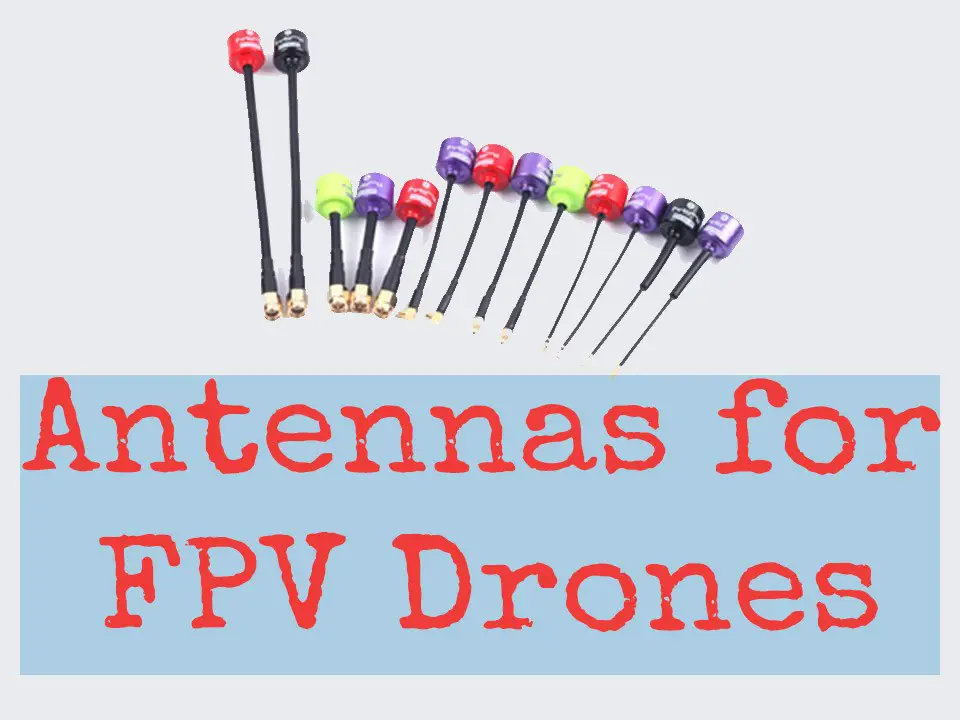
An antenna is usually made of three parts:
- Active element – the “business end” that actually transmits/receives RF
- Coaxial cable – connects the active element to your VTX/VRX
- Connector – SMA, RP-SMA, MMCX, U.FL, etc. that plugs into your VTX or goggles
When shopping, you don’t need to understand every RF spec on the datasheet. Focus on a few key ideas: polarization, directionality, connector type, frequency, weight and durability. The rest is fine-tuning.

Antenna Polarization: Linear vs Circular (And What You Should Use)
Polarization describes how the radio wave “wiggles” through the air. For FPV, there are two main types:
- Linear polarized (LP) – the wave is oriented in a straight line (vertical or horizontal)
- Circular polarized (CP) – the wave spins as it travels, like a corkscrew (either right-hand or left-hand)
Linear Polarized Antennas
In linear polarization, both antennas need to be aligned for the best signal. That means if your VTX antenna is vertical, your VRX antenna should also be vertical. If they’re at 90° to each other, you get a big signal loss.
Common linear antennas include:
- Monopole “wire” antennas
- Dipole antennas
- Some flat patch designs
Linear antennas are:
- Very light – great for tiny whoops and sub-250g builds
- Cheap and simple
- More sensitive to orientation and multipathing
Because quads are constantly tilting, rolling, and crashing, pure linear systems are not as forgiving for freestyle or racing on 5″ rigs. They are still very popular on tiny whoops and ultralight builds where every gram counts.
Circular Polarized Antennas
Circular polarized antennas spin the wave as it travels. The spin direction can be:
- RHCP – right-hand circular polarization
- LHCP – left-hand circular polarization
Common circular designs include:
- Cloverleaf
- Pagoda
- Skew planar wheel
- Helical
- Circular patch antennas
CP antennas are much more forgiving to orientation and help reject multipathing (reflections from walls, trees, and the ground that cause image tearing and breakup). That’s why most modern analog FPV setups use circular polarization at least on the quad, and often on both quad and goggles.
Can You Mix LP and CP Antennas?
Yes, you can mix them, but there’s a catch.
- Using LP on the quad and CP on the goggles is common on tiny whoops because LP antennas are very light and durable.
- You will lose some signal strength compared with CP-to-CP, but it’s still usually better than running LP on both ends with bad alignment.
If you’re flying a 5″ or heavier quad, stick to CP on both VTX and VRX unless you’re doing something very specific.
Can You Mix LHCP and RHCP?
No – or more accurately, you shouldn’t.
Mixing LHCP and RHCP means the antennas largely reject each other, and you’ll see a big drop in signal strength. That might be useful between pilots (to reduce interference at a race), but your own quad and goggles must match:
- RHCP on quad → RHCP on goggles
- LHCP on quad → LHCP on goggles
A useful trick: when flying with friends, use different polarizations for different pilots to minimize cross-interference, as long as each pilot keeps their own system matched.
Directional vs Omnidirectional Antennas

Directionality describes how the antenna spreads its energy in space.
- Directional antenna – focuses energy in a particular direction (like a flashlight)
- Omnidirectional antenna – spreads energy around (like a light bulb)
Omnidirectional Antennas
Omni antennas transmit and receive in all directions around the antenna. The signal is not as strong in any single direction compared with a directional antenna, but it’s much more consistent as the quad moves.
For FPV drones, this is usually what you want on the quad, because the quad constantly changes heading and attitude. You can’t keep a directional antenna on the quad always pointing at yourself.
Directional Antennas
Directional antennas focus the signal in a narrower beam. They offer:
- Higher gain (stronger signal) in a specific direction
- Weaker coverage behind and to the sides
These are ideal for the goggles or ground station, where the pilot is stationary and can point the antenna roughly toward the flying area. Examples: patch antennas and helical antennas.
Best Practice for FPV Systems
- On the quad (VTX) – use a CP omnidirectional antenna for most 3–7″ builds, or a lightweight LP dipole for tiny whoops and ultralights.
- On the goggles (VRX) – if you have diversity, combine one omnidirectional and one directional antenna. That gives you good near-field coverage plus strong range in the direction you’re flying.
Common FPV Antenna Types
Most antenna names refer to their physical design, which indirectly tells you their polarization and directionality.
| Direction | Linear Polarized | Circular Polarized |
|---|---|---|
| Omnidirectional | Monopole, dipole | Cloverleaf, pagoda, skew planar wheel |
| Directional | Some flat patch designs | Helical, circular patch |
In practice, most FPV antenna listings will clearly say:
- “5.8 GHz circular polarized omni” or
- “5.8 GHz LHCP patch antenna”
If you know whether an antenna is LP/CP and omni/directional, you’re already 90% of the way there. The exact geometry (pagoda vs cloverleaf) is less important than the overall quality and build.

Connector Types: SMA, RP-SMA, MMCX, U.FL and Friends
Connectors are the mechanical interface between the antenna and your VTX or goggles. If the connector doesn’t match, you can’t plug it in – or worse, you force it and break something.
The most common connector types in FPV are:
- SMA / RP-SMA – full-size threaded connectors, very durable but heavier
- MMCX – snap-in connector, smaller and lighter than SMA but still reasonably robust
- U.FL (IPEX) – tiny press-on connector, very light but fragile and only rated for limited plug/unplug cycles
Choosing the Right Connector
- SMA / RP-SMA – common on external modules and some VTX boards. Great for 5″ and larger builds where a few extra grams don’t matter.
- MMCX – widely used on modern VTX and HD systems (such as 5.8GHz modules). Good balance between size and durability.
- U.FL – commonly used on tiny whoops and ultralight HD builds. Treat them gently and avoid frequent removal.
You can use adapters between SMA and RP-SMA (or other combinations), but every adapter adds small losses and another failure point. Whenever possible, buy the antenna with the correct connector to match your hardware.
Frequency Range and Band (Analog & Digital FPV)
FPV video typically runs on:
- 5.8 GHz – the standard for most analog and many digital systems
- 2.4 GHz or 1.3 GHz – used in some long-range or special systems
Most pilots in 2026 are still using 5.8 GHz for their primary FPV link (analog or digital). That means you should choose antennas tuned for 5.8 GHz unless you deliberately run a different band.
Make sure your antenna matches your system’s frequency. A 2.4 GHz antenna on a 5.8 GHz VTX is basically useless, and vice versa. Good 5.8 GHz FPV antennas are designed to cover the typical FPV channel bands used by analog and compatible digital systems.
Weight, Durability, and Real-World Trade-Offs
Antenna weight can range from under 1 g (tiny dipoles) to over 10 g (large, fully protected CP antennas).
- Tiny whoops / 65–75 mm – every gram hurts flight time and performance. Lightweight LP dipoles or micro CP antennas with U.FL connectors are preferred.
- 5″ freestyle / racing – you can afford a sturdier CP antenna with SMA/MMCX, especially if you crash often.
- Long-range – you may choose slightly heavier but more robust antennas with better radiation patterns and protection.
Durability is a big deal for CP antennas because the active elements are often exposed. Modern “stubby” or fully molded antennas are much better at surviving tumbles and lawn darts than the old exposed cloverleaf designs.
Other RF Specs: Gain, Axial Ratio, VSWR, Efficiency
When you look at spec sheets, you’ll often see numbers like gain, axial ratio, VSWR, and efficiency. Here’s what they mean in plain language.
Antenna Gain (dBi)
Gain describes how strongly the antenna focuses its energy. Higher gain usually means:
- Stronger signal in a specific direction
- Narrower beam and less coverage to the sides or behind
For VTX antennas on the quad, you typically want low gain omni (around 1–2 dBi) for good coverage all around the quad.
For VRX antennas on the goggles, you can combine:
- Low-gain omni antenna
- Medium/high-gain directional patch
Axial Ratio
Axial ratio tells you how “perfect” the circular polarization is. An axial ratio of 1 is ideal – the closer to 1, the better the antenna is at maintaining its CP behavior and rejecting multipathing.
Good FPV CP antennas will usually have a low axial ratio, which translates to cleaner video, especially around reflective surfaces.
VSWR (Voltage Standing Wave Ratio)
VSWR measures how well the antenna is matched to the transmitter or receiver. A value of 1 is perfect. Higher values mean power is reflected back instead of radiated.
For FPV, you generally want VSWR below 2 across your operating band. That’s usually taken care of by reputable manufacturers – you don’t have to obsess over it, but it’s nice to know why it matters.
Radiation Efficiency
Efficiency describes how much of the input power ends up as radiated RF instead of being lost as heat or reflection. Higher efficiency means more of your VTX power actually reaches the air – and your goggles.
Again, quality antennas from known FPV brands usually have good efficiency. If the price looks too good to be true from a random no-name listing, it probably is.
Multipathing and Why CP Antennas Help

In real flying environments, radio waves bounce off walls, trees, metal structures, and even the ground. When multiple copies of the same signal arrive at your receiver at slightly different times, they interfere with each other. This is called multipathing.
Multipathing is what causes tearing, lines, and intermittent breakup when you fly behind objects or near reflective surfaces.
Circular polarization helps because when a circularly polarized wave bounces off a surface, its polarization is flipped (from RHCP to LHCP or vice versa). If your receiver antenna only “listens” to one polarization, a lot of the reflected energy is ignored, which reduces interference and improves clarity.
Is the Radio Antenna the Same as the FPV Antenna?
No – they are two different systems.
- Radio receiver antenna – handles control link (usually 2.4 GHz or 900 MHz). This is what your radio transmitter talks to.
- FPV antenna – handles video link (usually 5.8 GHz). This is what your goggles/VRX listen to.
They may look similar, but they are tuned differently and use different hardware. Don’t swap them around unless you really know what you’re doing. If you want to learn more about the radio side, check out our guide.

Best FPV Antennas in 2026 (By Use Case)
Now that the theory is out of the way, let’s talk about actual gear you can buy today. These recommendations focus on 5.8 GHz FPV antennas that are realistic to get from major FPV retailers and perform well for their category.
To keep things simple, we’ll split recommendations into:
- Tiny whoops and ultralight builds
- 5″ and general freestyle/racing quads
- Goggle/VRX antennas (omni and directional)
Best FPV Antennas for Tiny Whoops and Ultralight Builds
On whoops and sub-250g quads, weight is king. You usually want a light LP or micro CP antenna, often with a U.FL connector, that can survive lots of whoop-style crashes.
NewBeeDrone BeeTX 5.8GHz Antenna (U.FL)

Type: Linear polarized, ultralight, U.FL
The NewBeeDrone BeeTX 5.8GHz antenna is a tiny, lightweight LP antenna designed for micro builds. It’s a great choice if you want to keep your whoop light but still have a clean, flyable signal for indoor tracks and small outdoor spots.
- Extremely light, ideal for 1S and 2S whoops
- U.FL connector makes it a direct fit on many AIO whoop flight controllers
- Durable enough for repeated whoop-style crashing
GEPRC Peano 5.8GHz Antenna (U.FL/MMCX)

Type: Circular polarized, lightweight, U.FL/MMCX options
If you prefer circular polarization on your micro or lightweight build, the GEPRC Peano 5.8GHz antenna is a compact CP option with excellent efficiency and low weight. It comes in U.FL and MMCX variants to fit a range of VTX and HD systems.
- CP design for better multipath resistance on small outdoor courses
- Available in RHCP and LHCP to match your system
- Very light and slim, ideal for 2.5–3.5″ and lightweight cinewhoops
Best FPV Antennas for 5″ Freestyle and Racing
For 5″ and larger quads, you want a robust CP omni antenna with a good protective shell. It should survive hard crashes and still give you solid performance on both analog and digital 5.8 GHz systems.
Lumenier Micro AXII Stubby 5.8GHz Antenna

Type: Circular polarized, omnidirectional, stubby form factor
The Lumenier Micro AXII series has earned a reputation for excellent performance, compact size, and durability. The stubby versions are especially popular on 5″ freestyle rigs where antennas are frequently smacked into trees, gates, and the ground.
- Near-perfect axial ratio and very good efficiency for a clean video feed
- Stubby profile makes it less likely to get snapped in crashes
- Available in multiple connectors (SMA, MMCX, U.FL) and polarizations
GEPRC Momoda2 5.8G DUAL Antenna

Type: Circular polarized, omnidirectional, full-size
The GEPRC Momoda2 5.8G DUAL antenna is a robust, full-length CP antenna with a well-optimized radiation pattern. It’s a solid choice if you prefer a “standard” length antenna for better clearance above the frame and electronics.
- Good gain and coverage for mixed freestyle and medium-range flying
- ABS shell and FPC+PCB structure for durability and consistency
- Ideal for 5″ and 7″ builds where weight is less critical than robustness
Best FPV Antennas for Goggles and VRX
Your goggles are just as important as the quad. A good combination is usually one high-quality omni and one directional patch if your goggles support diversity.
GEPRC Peano 5.8GHz Antenna (Goggle Omni)
Type: Circular polarized, omnidirectional
The same GEPRC Peano antenna mentioned above that works well on quads also works great as an omni antenna on your goggles or VRX. It gives you consistent coverage around your flying area with minimal fuss.
Micro CP Patch Antenna for Long-Range/Focused Flying
Type: Circular polarized, directional patch
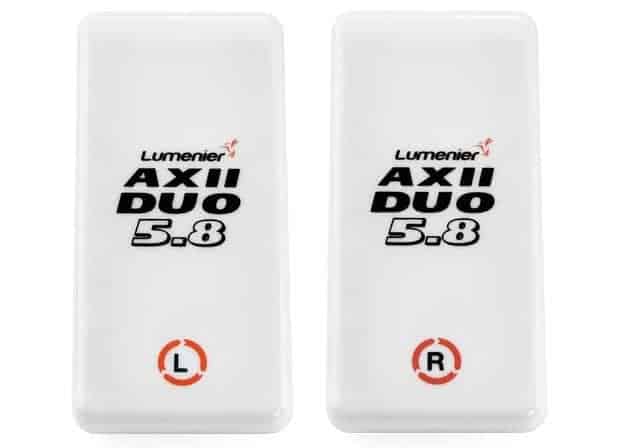
The Lumenier Axii Duo Patch is a directional, circularly polarized antenna ideal for your goggle’s diversity system. It has a beam width of 80° horizontally and 40° vertically, which is good enough to cover your drone in most scenarios.
Unless you are flying only long range, you should use the Axii Duo Patch together with an omnidirectional antenna for better signal coverage.
If your budget is tight, consider the Lumenier Axii Patch. It has only 1 active element instead of 2 in the Duo Patch. So, do expect shorter range and narrower coverage. But it still gets the job done.
Practical Setup Examples
Indoor Tiny Whoop Setup
- Quad VTX antenna: NewBeeDrone BeeTX 5.8GHz Antenna (U.FL)
- Goggles: Dual omni antennas (CP or LP) for full coverage around the house or small track
This setup keeps your whoop light, while the goggles do the heavy lifting for reception.
5″ Freestyle Rig
- Quad VTX antenna: Lumenier Micro AXII Stubby 5.8GHz Antenna (SMA/MMCX)
- Goggles: One GEPRC Peano 5.8GHz omni + one CP patch
You get a tough, reliable antenna on the quad and a strong, flexible reception setup on your head.
Medium-Range / Mountain Freestyle
- Quad VTX antenna: GEPRC Momoda2 5.8G Antenna
- Goggles: High-quality CP patch plus omni
This gives you better penetration and range in the general direction you’re flying, as long as you keep roughly in front of your patch antenna.
Final Thoughts on Choosing an FPV Antenna in 2026
You don’t need to become an RF engineer to pick a good FPV antenna. Focus on a few key rules:
- Use 5.8 GHz CP omni antennas on most quads, unless you’re on a tiny whoop where a light LP dipole makes more sense.
- Match polarization (RHCP with RHCP, LHCP with LHCP) between quad and goggles.
- Use omni on the quad and a mix of omni + directional on the goggles if you have diversity.
- Choose the correct connector (SMA / RP-SMA / MMCX / U.FL) so you don’t need adapters.
- Prioritize weight and durability for whoops, and durable CP stubbies for 5″ and bigger.
As long as you stick to reputable brands and follow these basics, your FPV antenna will quietly do its job in the background – which is exactly how it should be. Spend less time fighting breakup and more time actually flying. And when you’re ready for the next step, pair your antennas with a solid VTX and radio link – or dive into our guide on how to build your first quad to put it all together.